
Bagel.co moves funds between accounts that they operate on behalf of their customers. Customers 1-3 buy and sell bagels to each other, and cash out the balances of their accounts on your platform to external banks. If the company pays its monthly rent of $2,000, a credit entry of $2,000 will be recorded in its Cash account and a $2,000 debit entry will be recorded in its Rent Expense account. In simple terms, when your business makes any transaction, it affects at least two accounts. For example, when you buy office supplies with cash, you’re increasing your supplies (an asset) while decreasing your cash (another asset). The total value remains the same, but the composition of your assets changes.
How Does Double Entry Bookkeeping Work?
There are two columns in each account, with debit entries on the left and credit entries on the right. In double entry accounting, the total of all debit entries must match the total of all credit entries. Accurate debits and credits are central to double-entry bookkeeping, and it’s your bookkeeper’s job to ensure each transaction keeps your accounts balanced and error-free. The principle of double-entry accounting is that every financial transaction has equal and opposite effects on at least two double-entry accounting accounts.
B. Impact of transactions on the accounting equation

Also, because there’s a clear and detailed record of all financial transactions, it’s harder for employees or upper management to manipulate or conceal information. The double-entry system is distinct from single-entry bookkeeping, where you just list expenses and revenues. Single-entry accounting is more straightforward and works for very small businesses with only a handful of transactions to keep track of.
In other words, why is this bookkeeping method so important?

A ledger (also called a general ledger, accounting ledger, or financial ledger) is a record-keeping system for a company’s financial transaction data. For businesses that move money as part of their core business, like marketplaces, it is recommended that they use double-entry accounting. Not only does it enable accurate calculations and simplify the preparation of financial statements, it also helps to reduce the risk of errors or fraud.

These reports are essential for stakeholders to evaluate the company’s performance and make informed decisions. The dual-entry approach facilitates the generation of these statements, providing a clearer picture of assets, liabilities, and equity. Debits and credits are the fundamental building blocks of double-entry accounting. Every transaction involves at least one debit and one credit entry, ensuring that the accounting equation remains balanced.
- A credit entry represents money received or reduced liabilities, while a debit entry represents money paid out or an increase in assets.
- On the other hand, the double-accounting system involves recording each transaction in two accounts—both a debit and a credit.
- This can help businesses to avoid stockouts and reduce the risk of overstocking.
- Single-entry accounting involves writing down all of your business’s transactions (revenues, expenses, payroll, etc.) in a single ledger.
- In summary, balancing accounts and utilizing the trial balance are integral steps in the double entry accounting process.
Suppose ABC takes a short-term loan with a maturity period of 3 months for a total amount of $ 50,000. For the past 52 years, Harold Averkamp (CPA, MBA) hasworked as an accounting supervisor, manager, consultant, university instructor, and innovator in teaching accounting online. For the past 52 years, Harold Averkamp (CPA, MBA) has worked as an accounting supervisor, manager, consultant, university instructor, and innovator in teaching accounting online.
The History of Double-Entry Accounting
This rule emphasizes the relationship between individuals and the business, ensuring that all transactions involving personal accounts https://taherizadehmind.com/what-is-a-goods-received-note-grn-and-why-they-are/ are recorded correctly. It highlights the importance of recognizing who is benefiting from the transaction. Another significant benefit of double-entry bookkeeping is its ability to facilitate error detection. Since each transaction involves both a debit and a credit, discrepancies can be identified more easily when accounts are reconciled. This dual-entry system acts as a built-in check, helping to minimize the risk of mistakes that could lead to financial misstatements.
- Each example maintains the balance of the accounting equation, demonstrating the double-entry system’s role in keeping the financial records accurate and reliable.
- The general ledger is like a central repository of all the accounts used in a business.
- Understanding the difference between single- and double-entry bookkeeping can help you manage your business’s finances better.
- For example, when a company purchases inventory for cash, the inventory account is debited (increased) and the cash account is credited (decreased).
- An example may include money paid towards a bank loan – this debits (decreases) the revenue accounts.
- The total debits ($1,000) must always equal the total credits ($1,000), ensuring the accounting system is accurate and error-free.
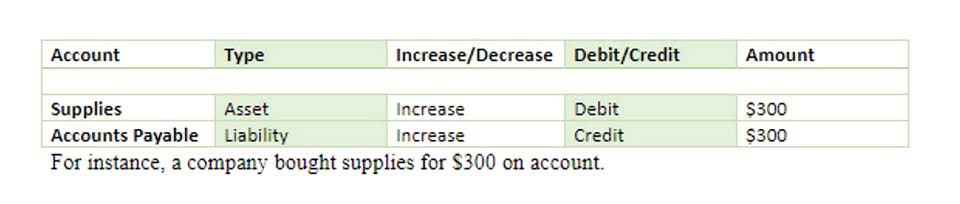
For example, an e-commerce company buys $1,000 worth of inventory on credit. Assets (the inventory account) increase by $1,000 and liabilities (accounts payable) increase by $1,000. For businesses in the United States, the Financial Accounting Standards Board (FASB), is a non-governmental body.
It’s quick and easy—and that’s pretty much where the benefits of single-entry end. This entry records the increase in accounts receivable (an asset) and the increase in sales revenue (an equity account). With that in mind, double-entry normal balance accounting is still the best option for most companies. This is because this bookkeeping method provides a strong and structured process to account for your business’s finances. Single-entry accounting may be appropriate for very small businesses, as there is much less data and variables to account for.